




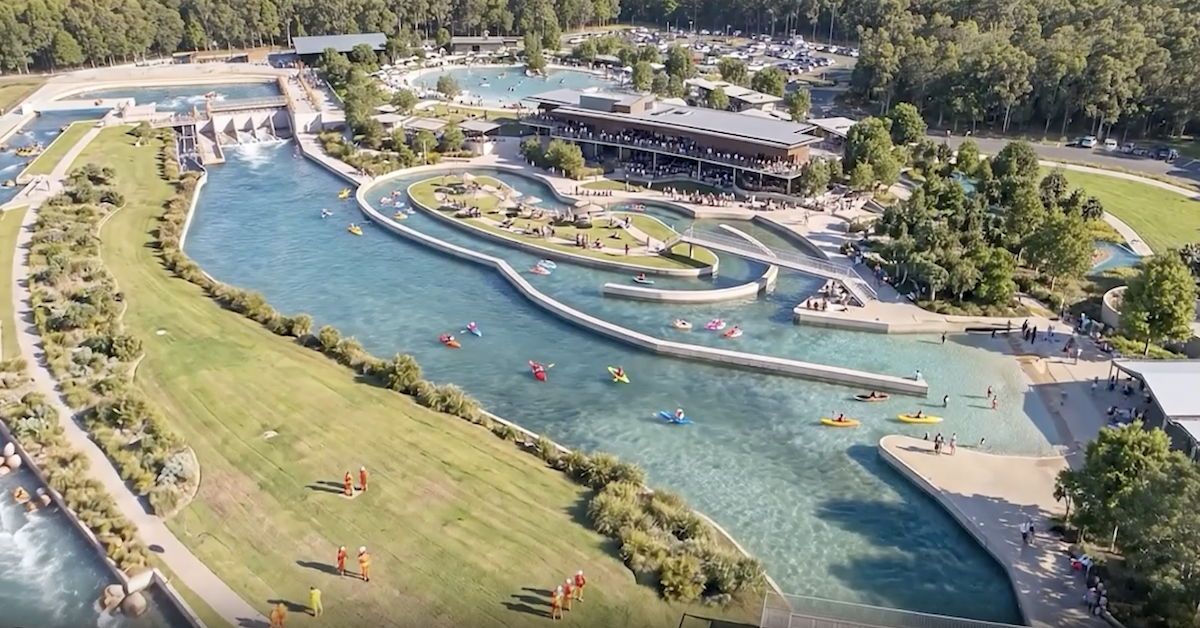
The Redland Whitewater Centre at Birkdale will be designed by Queensland engineering firm GHD and international whitewater specialist Whitewater Parks International (WPI), advancing plans for the Brisbane 2032 Olympic canoe slalom venue.
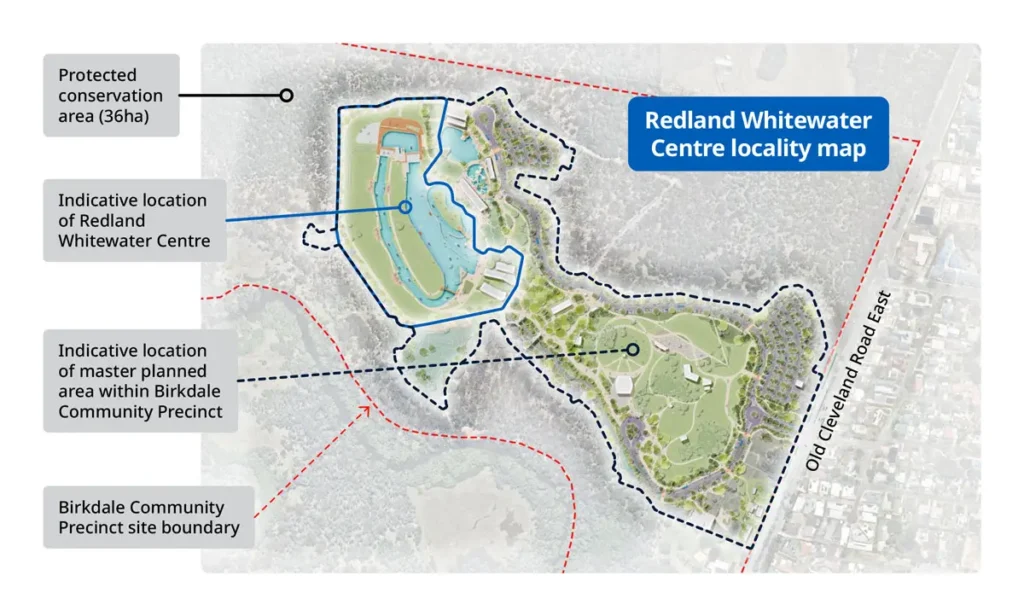
The appointment, announced on 20 November 2026, follows a procurement process launched late last year. The centre will form part of the planned 62-hectare Birkdale Community Precinct, with facilities designed for Olympic competition, public recreation and emergency services training.
GHD previously designed Auckland’s Vector Wero Whitewater Park, while WPI worked on whitewater facilities for the Tokyo 2020 and Rio 2016 Olympics. Members of the WPI team also contributed to venues used during the Sydney 2000 and London 2012 Games.
The Games Independent Infrastructure and Coordination Authority (GIICA) will oversee the project under the jointly funded $7.1 billion Games Venues Infrastructure Program, which covers multiple Olympic venues across Queensland.
Whitewater Course Planned Alongside Community Lagoon
The proposed centre will feature an international-standard whitewater channel for canoe slalom and rafting, a central lake and a lazy river for recreational use outside competition periods.
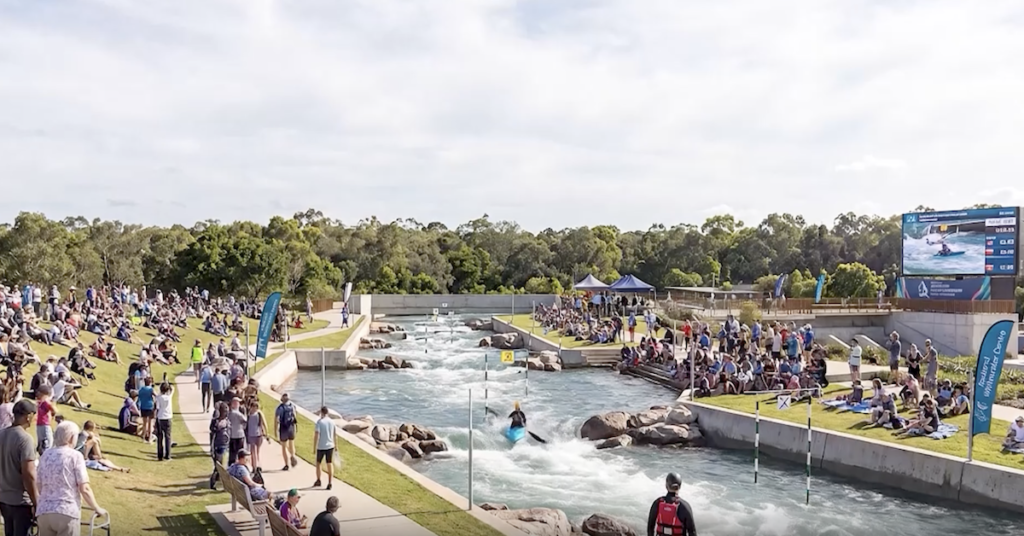
Plans also include changerooms, boat storage, spectator terraces and temporary seating for Olympic crowds. The venue would become Australia’s second purpose-built Olympic-standard whitewater facility, following Penrith Whitewater Stadium in Sydney.
The surrounding precinct is planned to include a public swimming lagoon, children’s waterplay areas, recreational spaces and food and beverage facilities.
Redland City Council released refined plans for the Birkdale Community Precinct in August, including a 2,000-square-metre lagoon and additional tourism attractions. Council expects enabling works across the precinct to begin in 2027, with facilities intended to open before the Games. The latest announcement did not provide a construction start date for the whitewater centre.
Industry Estimate Puts Whitewater Centre at $250 Million
Redland City Council is expected to take responsibility for operating and maintaining the whitewater centre after the Olympics, placing its long-term financial performance under scrutiny.
A 2025 Queensland Major Contractors Association estimate placed the project’s potential total cost at approximately $250 million, including an estimated $182.5 million in engineering construction. The association cautioned that its figures were preliminary and had not been verified by Games authorities, while the latest design announcement provided no updated project budget.
Concerns about operating costs have also prompted comparisons with Penrith Whitewater Stadium, which has recorded losses in most years since 2008. Critics have questioned whether revenue from rafting, training and events would be sufficient to cover Birkdale’s ongoing expenses.
Acting Mayor Julie Talty said in August that council’s financial modelling indicated the centre could cover its operating costs and help subsidise the neighbouring public lagoon.
Council’s projections remain untested against actual visitor numbers, revenue and maintenance expenses, with the venue’s financial performance yet to be demonstrated.
Federal Environmental Decision Upheld After Challenge
Environmental concerns have been another source of opposition to the development, particularly the potential effects of construction on groundwater and nearby koala habitat.
Community organisations, including Redlands2030 and Koala Action Group Queensland, sought further federal scrutiny, arguing that changes to groundwater conditions could affect vegetation supporting endangered koalas.
The Commonwealth reconsidered its earlier environmental decision and upheld the original determination on 17 September 2026. The project remains classified as a Not Controlled Action – Particular Manner under the Environment Protection and Biodiversity Conservation Act 1999, allowing it to progress in accordance with specified federal environmental requirements while remaining subject to other applicable approvals.
Council has identified environmental measures including approximately 10,000 native plantings, habitat improvements, koala monitoring and fully lined whitewater channels intended to prevent groundwater interaction.
Council’s precinct plans designate approximately 39 hectares, or 62 per cent of the site, for conservation, protection and ecological enhancement, with the proposed development footprint covering less than 20 hectares.
Emergency Training and Recreation Planned After 2032
The whitewater centre is intended to operate beyond the Olympics as a venue for recreational paddling, rafting, sporting events and emergency services training.
Queensland Fire Department Commissioner Steve Smith has identified the facility as a potential training location for firefighters undertaking swiftwater rescue exercises. It could also support joint training between emergency services agencies.
Olympic champion Jessica Fox and Paddle Australia president Andrew Trim have backed the project, citing opportunities for young paddlers, athlete development and future international competitions.
GHD and WPI will now develop the venue’s detailed design, with the project still requiring further design work and applicable approvals before construction can proceed.
Published 20-Nov-2026