



Queensland had done the hard part.
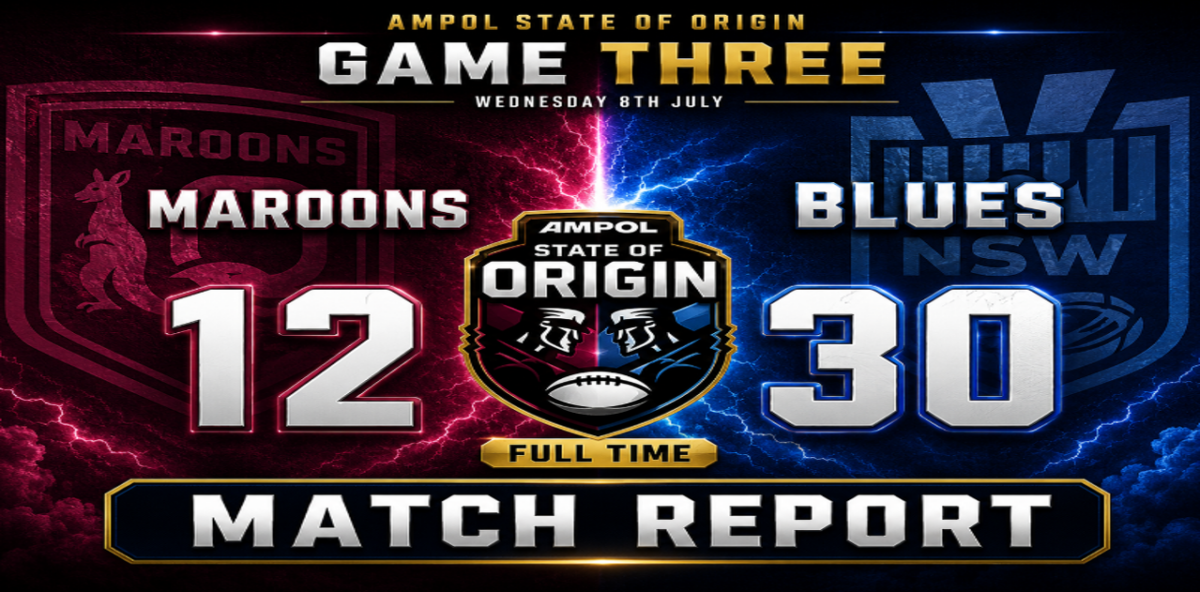
After losing the series opener, the Maroons responded in Perth to force a State of Origin decider back to Suncorp Stadium, putting themselves within 80 minutes of retaining the shield. What they couldn’t do on Wednesday, July 8, was wrestle control of the contest away from Nathan Cleary and a New South Wales side that dominated territory, possession and the biggest moments on its way to a 30-12 victory.
Cleary scored two tries, kicked four conversions and a penalty goal before collecting the Wally Lewis Medal as player of the 2026 series, but his greatest influence came through his game management. Whenever Queensland looked capable of building pressure, the Blues halfback calmly steered the contest back onto New South Wales’ terms.
Queensland Lost The Territory Battle
The opening quarter was as tight as any Origin decider should be. Both teams spilled early possession, neither side found much attacking rhythm and there was little to separate them until New South Wales began winning the battle that shaped the rest of the night — field position.
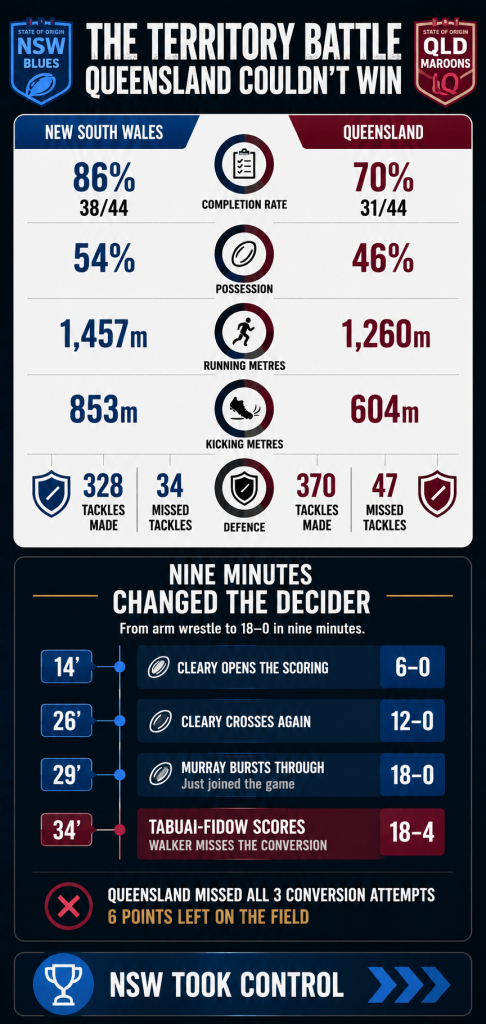
The Blues completed 38 of their 44 sets at 86 per cent, while Queensland managed 31 completions from the same number of opportunities at 70 per cent. That gap flowed through the key statistics. New South Wales enjoyed 54 per cent possession, held the ball for nearly four-and-a-half minutes longer, ran for 1,457 metres to Queensland’s 1,260 and finished with 853 kicking metres compared with the Maroons’ 604.
Queensland’s effort in defence could hardly be questioned. The Maroons made 370 tackles but missed 47, compared with 34 by the Blues, while repeated defensive sets gradually allowed New South Wales to wear Queensland down.
Nine Minutes That Mattered
Queensland had defended strongly enough to stay in the contest until Cleary broke through for the opening try in the 14th minute.
The match then swung decisively.
Stephen Crichton’s line break created Cleary’s second try before Cameron Murray, only moments after entering from the interchange, burst through the middle after breaking the line himself to extend the lead to 18-0. In the space of nine minutes, an arm wrestle had become a chase.
Hamiso Tabuai-Fidow’s try shortly before halftime gave Queensland hope, but Sam Walker’s missed conversion left the Maroons trailing 18-4 rather than within two converted tries. It proved the first of three missed conversion attempts that ultimately left six points on the field.
The Comeback Never Came
Queensland emerged after the break with renewed energy.
Consecutive set restarts finally pinned New South Wales inside its own half before Selwyn Cobbo crossed to reduce the margin to 18-8 and lift the Suncorp crowd.
The Blues answered almost immediately.
Bradman Best restored the three-score advantage after another polished attacking movement before Cleary converted. Jojo Fifita’s second-half try again gave Queensland a chance to build, but another missed conversion meant the Maroons still hadn’t fully capitalised on their opportunities.
The three missed conversions were costly, but they reflected a broader problem. Queensland never generated enough sustained pressure to make New South Wales uncomfortable. Thirteen handling errors repeatedly handed the initiative back to the Blues, whose kicking game and completion rate ensured the Maroons were constantly working out of their own end.
Blues Finish The Job
New South Wales also overcame setbacks that could easily have unsettled the side. Captain James Tedesco failed a head injury assessment late in the first half and did not return, while Jack Bostock also failed a head injury assessment after the break.
The Blues barely changed.
Their defensive structure remained intact, Cameron Murray’s impact from the bench strengthened the middle and Cleary continued to dictate the contest until a late penalty goal effectively sealed the result before Hudson Young crossed after the full-time siren.
Queensland will review a completion rate of just 70 per cent, 13 handling errors and a night spent chasing territory. New South Wales completed their sets more consistently, kicked more effectively and trusted Cleary to control the biggest moments. On a night when the Maroons needed to dictate terms at Suncorp, they never managed to do it, and the Origin shield is heading back to New South Wales.
Match Summary
Queensland Maroons 12 (Hamiso Tabuai-Fidow, Selwyn Cobbo, Jojo Fifita tries)
lost to
New South Wales Blues 30 (Nathan Cleary 2, Cameron Murray, Bradman Best, Hudson Young tries; Nathan Cleary 4/5 goals, penalty goal)
Halftime: New South Wales 18-4
Wally Lewis Medal: Nathan Cleary (New South Wales)
Published 8-July-2026